Ask someone in Mexico whether Día de los Muertos is the Mexican Halloween and you will get a polite correction. Halloween is a night for scaring the dead away. Day of the Dead is two days for inviting them home, with their favourite meal on the table and a path of orange petals leading to the door. The skulls look similar from a distance. The meaning could not be more different.
This guide takes the Happy Living film on living in Mexico at the end of October and fills in what a visitor needs to know before standing in a cemetery at midnight: what the altars mean, where the tradition comes from, and where to experience it respectfully.
Watch the Film First
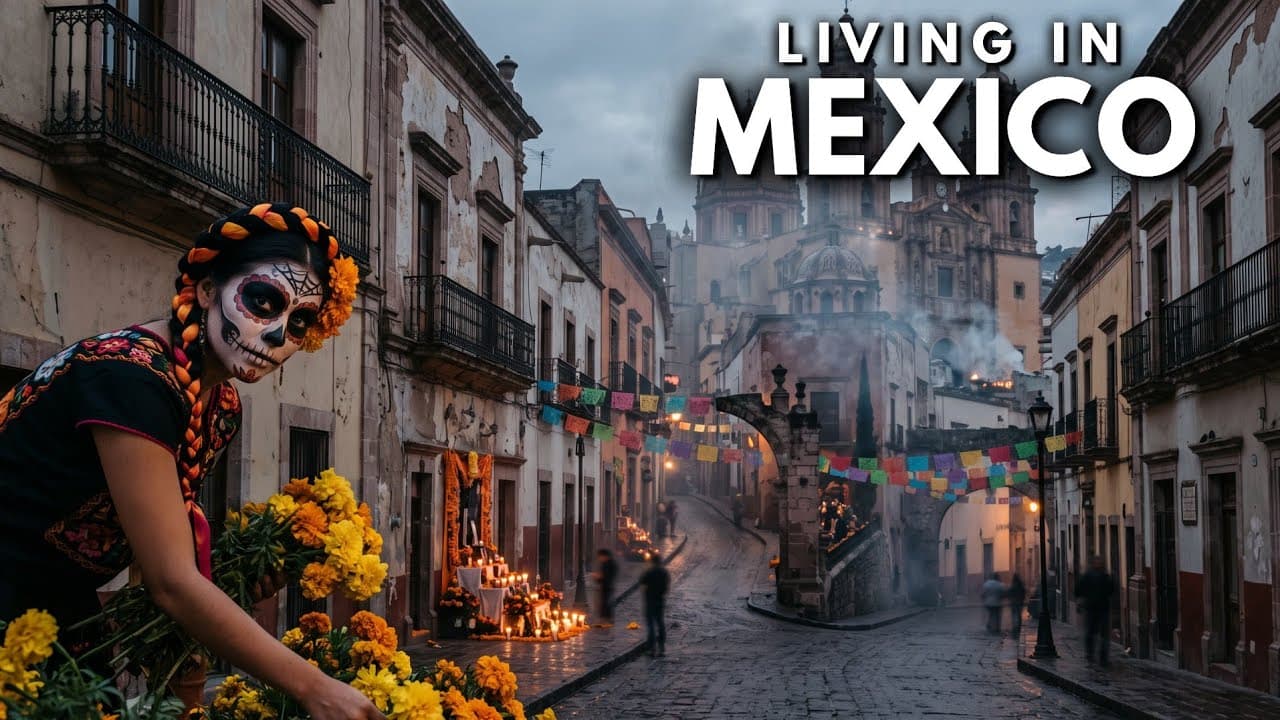
The film follows the last days of October and the first of November as Mexico prepares for its dead. It moves from flower markets stacked with cempasúchil to home altars built layer by layer, then out into the cemeteries after dark, where families sit beside candlelit graves until dawn. Along the way it draws the line that confuses most foreign visitors: children in plastic masks asking for sweets on one street, and a grandmother placing a glass of her late husband's favourite mezcal on an altar on the next. Both happen in Mexico. Only one is Día de los Muertos.
Why the Dead Come Home: Ofrendas, Marigolds and the Real Meaning
The core belief is simple and ancient. For a short window at the start of November, the boundary between the living and the dead thins, and the souls of the departed return to spend time with the families who remember them. November 1 is Día de los Angelitos, the day for children who died, and in many towns the little souls are welcomed from the evening of October 31. November 2 is for the adults. Some regions add earlier days for those who died in accidents, but the two-day heart of the festival is the same across the country.
The roots go back long before the Spanish arrived. The Mexica, the people most of us call the Aztecs, held a month-long festival for the dead in late summer, presided over by Mictecacihuatl, the Lady of the Dead who ruled the underworld of Mictlan. Death in that worldview was another stage of a journey, and skulls were displayed as symbols of rebirth rather than horror. Catholic missionaries in the sixteenth century could not stamp out the rituals, so they moved them, folding the indigenous festival into All Saints' Day on November 1 and All Souls' Day on November 2. The blended result was recognised by UNESCO as Intangible Cultural Heritage in 2008.
This is the fundamental reason it is not Halloween. Halloween descends from Samhain, the Celtic new year festival in which spirits were a danger to be warded off, a story we tell in full in our guide to Ireland, where Halloween began. Día de los Muertos descends from a tradition in which the dead are honoured guests. One tradition dresses up to hide from ghosts. The other sets a place at the table for them. The closest parallel is probably not Halloween at all but the Toraja highlands of Indonesia, where families also keep the dead close, as we found in our film on living with the dead in Toraja.
The ofrenda, the home altar, is where the festival actually lives. It is built in the days before November 1 on a table or stepped structure, usually with two, three or seven levels representing the stages between earth and heaven, and everything on it has a job. Photographs tell the souls which house is theirs. Cempasúchil, the Mexican marigold, provides the colour and, more importantly, the scent; families believe the smell guides the dead home, which is why petals are scattered in a trail from the street to the altar. Papel picado, the cut tissue-paper banners, represents the wind. Candles light the way, a glass of water quenches a soul that has travelled far, and a dish of salt purifies it. Then comes the food, which is where the altar becomes personal: the mole the person loved, the beer they drank, the sweets they kept in a drawer, plus pan de muerto, the orange-blossom bread topped with a dough cross of bones, and sugar skulls with the name of the departed written in icing across the forehead.
Where to Experience It: Oaxaca, Mixquic and Pátzcuaro
Oaxaca is the destination most travelers choose, and for good reason. The city fills with comparsas, costumed street processions with brass bands that wind through neighbourhoods like Jalatlaco and the villages of the Etla valley, and the markets overflow with marigolds and sand tapestries. The two cemeteries to know are the Panteón General in the city, where candles burn through the night of November 1, and the cemetery at Xoxocotlán, a short taxi ride south, which hosts one of the most photographed vigils in Mexico. It is also the most crowded, so arrive early and give families space.
San Andrés Mixquic sits on the southeastern edge of Mexico City in the borough of Tláhuac and still feels like the farming village it was before the city swallowed it. On the night of November 2 the cemetery around the parish church holds La Alumbrada, the lighting, when thousands of candles are lit on the graves at once and the churchyard glows gold through the smoke of copal incense. It is an easy evening trip from the city and feels far older than the downtown celebrations.
Pátzcuaro, in the highlands of Michoacán, is the third great pilgrimage. The Purépecha communities around Lake Pátzcuaro keep some of the most intact pre-Hispanic traditions in Mexico, and on the night of November 1 the island of Janitzio, reached by small boats from the Pátzcuaro dock, becomes an island of candlelight as families keep vigil until sunrise. Smaller lakeside villages such as Tzintzuntzan are quieter and often more moving.
Mexico City's enormous parade down Paseo de la Reforma, with its giant Catrinas, is the newest piece of the puzzle. It did not exist until 2016. The opening scene of the James Bond film Spectre, released in 2015, showed a Day of the Dead parade that had never actually happened, and the city created one the following year for the visitors who came looking for it. It is spectacular and worth seeing, but it is a spectacle layered on top of a living tradition, not the tradition itself. Even La Catrina herself is younger than she looks: she began as La Calavera Garbancera, an etching made around 1910 by José Guadalupe Posada, a skull in a fancy European hat mocking Mexicans ashamed of their indigenous roots, and Diego Rivera gave her the name Catrina in a 1947 mural. Her message, that death makes everyone equal no matter how fine the hat, is the whole holiday in one image.
What It's Really Like to Visit
Día de los Muertos rewards travelers who go slowly, stay up late and treat the cemeteries as what they are: family gatherings they have been allowed to witness.
- Best dates: The evening of October 31 through the night of November 2. Oaxaca and Pátzcuaro sell out months ahead, so book accommodation by summer at the latest and expect prices to roughly double for that week.
- Getting there: Fly into Mexico City. For Oaxaca, ADO runs comfortable buses from the TAPO terminal that take roughly six to seven hours, or take the short flight. Pátzcuaro is about an hour by bus from Morelia, which has frequent buses from the capital.
- Where to base: Oaxaca's centro for walkable access to markets, comparsas and the Panteón General; Roma or Condesa in Mexico City for the parade and an evening trip to Mixquic; Pátzcuaro town for the lake vigils.
- Costs: Mexico is affordable outside the holiday premium. Budget about 1,500 to 2,500 pesos per person per day for a mid-range trip, and less if you eat at markets, which you should.
- Cemetery etiquette: Always ask before photographing a family or a grave, and accept a no. Bring a candle or a bunch of cempasúchil if you are invited to sit. Never touch an ofrenda or take food from an altar. Keep voices low and do not treat the vigil as a party; some families will share mezcal with you, others want to grieve quietly.
- Face paint: Catrina face painting is welcomed in the processions and the parade. Keep it out of the cemeteries unless locals around you are doing the same.
- Safety: Oaxaca, Pátzcuaro and central Mexico City are well used to visitors. Use official taxis or ride-share apps at night, keep valuables out of sight in crowds, and check current travel advice for anywhere beyond the main destinations.
- Weather: Early November is the start of the dry season. Oaxaca gives warm days around the mid-20s Celsius and cool evenings. Pátzcuaro sits at roughly 2,100 metres and the lakeside nights are genuinely cold, so bring a proper jacket for the vigil.
For a very different night among the dead, compare the ghost walks in our Gettysburg guide or the Dracula legends of Transylvania. Both are built on fear. Mexico is built on love.
What to Pack for Mexico
Pack for warm days, cold cemetery nights and a lot of standing around in crowds.
Affiliate picks, not a shopping checklist. Use what you own first. Check the listing's model, size, seller and current availability before purchasing.
Day of the Dead Culture Book
An illustrated introduction to the history, symbols and regional traditions of Día de los Muertos. Read it before you build or visit an ofrenda.
Rick Steves Mexico Travel Guide
Practical coverage of Mexico City, Oaxaca and the colonial highlands, with bus routes and neighbourhood tips. Check for the latest edition.
Spanish Phrasebook (Latin America)
Asking permission before you photograph a grave matters, and a few polite phrases in Spanish go a long way at a family vigil.

Packing Cubes Set
Mexico City to Oaxaca by bus, packing cubes keep your bag organized when you are moving fast between cities and late-night cemetery visits.
FAQ
Is Day of the Dead the same as Halloween?
No. Halloween grew out of the Celtic festival of Samhain and is about warding off spirits with costumes and carved lanterns. Día de los Muertos grew out of Mexica rituals for the dead blended with the Catholic feasts of All Saints and All Souls, and it is about welcoming the dead back for a visit. Kids in Mexican cities do go trick-or-treating on October 31, but Mexicans treat that as an imported party and keep it separate from the family altars and cemetery vigils of November 1 and 2.
Can tourists go to the cemeteries during Día de los Muertos?
Yes, the major cemeteries in Oaxaca, Mixquic and the Pátzcuaro region are open to visitors and families generally welcome respectful outsiders. Ask before taking photographs, do not use flash, do not touch graves or altars, and remember that you are standing beside people who may be mourning someone who died this year.
When should I book a trip for Day of the Dead in Mexico?
Reserve accommodation in Oaxaca or Pátzcuaro at least four to six months ahead, and earlier for the best-located guesthouses. ADO bus seats and the short Oaxaca flights fill up in the final week of October, so book those as soon as your dates are set.
What should I put on an ofrenda if I build one at home?
Start with a photograph of the person, then add the four elements: candles for fire, a glass of water, salt and food for earth, and papel picado for wind. Marigolds, pan de muerto and sugar skulls are the traditional extras. The most important items are the ones the person actually loved, whether that is a bottle of their beer or a packet of their favourite biscuits.
Watch More from Happy Living
Mexico in early November is one of the most moving places on Earth to think about how the living remember the dead. Browse the full Happy Living film collection for the Irish origins of Halloween, the Toraja highlands and the haunted battlefield at Gettysburg, or subscribe on YouTube to catch each new film the week it is released. The journal has a companion guide for every destination.