Every plastic skeleton, every carved pumpkin and every child shouting "trick or treat" on a suburban doorstep traces back to Ireland. Halloween was not invented in America and it was not invented by a candy company. It grew out of Samhain, a Celtic festival at least 2,000 years old that marked the end of the harvest and the one night of the year when the dead were believed to walk back among the living.
This guide takes the Happy Living film on the Irish origins of Halloween and follows the story to the places where it happened: a windy hill in County Meath where the sacred fire was lit, a muddy cave in County Roscommon that medieval scribes called the gate to hell, and the festivals that keep the old night alive.
Watch the Film First
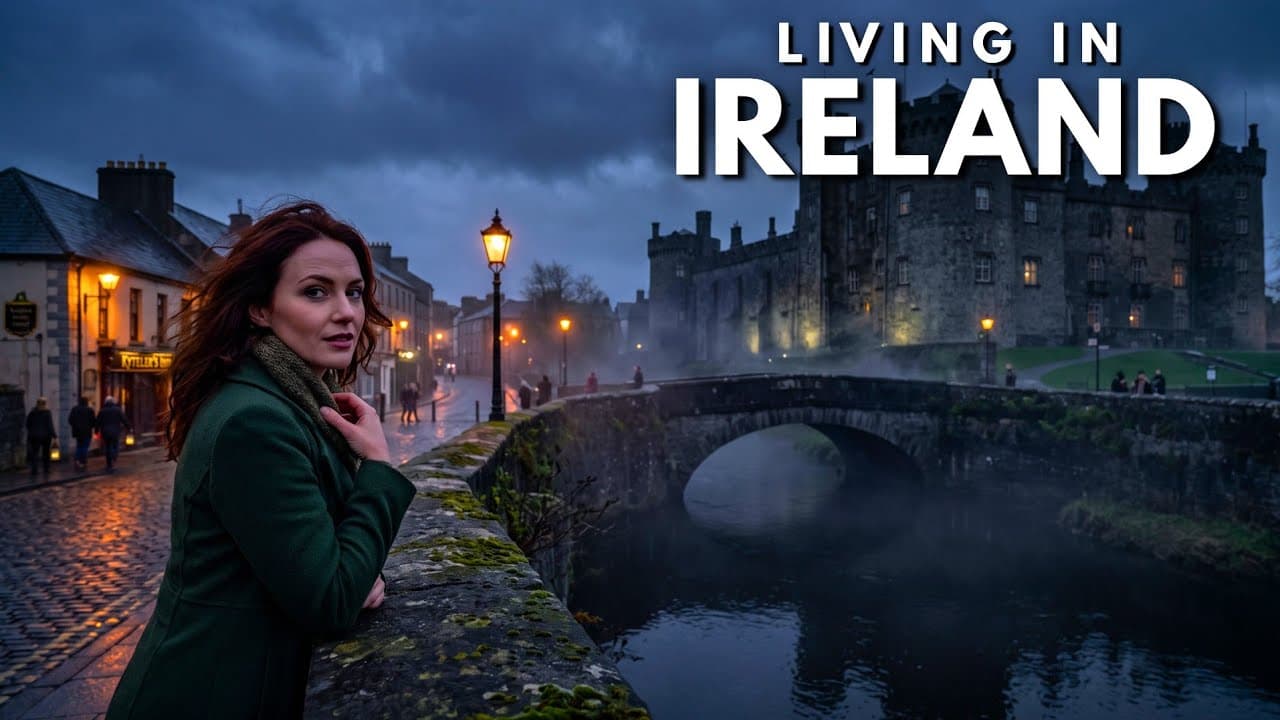
The film travels through the Irish countryside in the weeks before Halloween, when the fields are stubble, the light goes early and the pubs are full by five. It visits the Hill of Ward outside Athboy, the royal landscape of Rathcroghan and the crawl-in entrance of Oweynagat, then ends among the lanterns of the modern festivals, asking farmers, guides and publicans why a fire festival older than Christianity still matters to them.
Samhain, the Hill of Ward and the Night the Dead Came Home
Samhain, pronounced roughly "sow-in", fell on the night of October 31 into November 1 and marked the turn of the Celtic year. The harvest was in, the cattle had come down from summer pasture, and the dark half of the year began. The hinge between light and dark was dangerous. On that one night the boundary between this world and the Otherworld thinned, and the dead, along with the aos sí, the fairy folk who lived under the hills, could cross over. Households left food out for returning ancestors and stayed off the roads after dark. Wearing a disguise began here too, as a way of hiding from spirits or blending in with them.
The ceremonial center of all this, according to medieval Irish sources, was the Hill of Ward, called Tlachtga in Irish, a low grassy rise just outside Athboy in County Meath. The 17th-century historian Geoffrey Keating described a great fire lit there at Samhain by the druids, from which every other hearth in Ireland was rekindled. For centuries that read like legend. Then excavations in the 2010s found evidence of large-scale burning on the hill dating back more than a thousand years, along with animal bone and a huge ceremonial enclosure. There is no ticket office, just a roadside gate, and on a grey October afternoon with the wind coming across the fields it is one of the most atmospheric places in Ireland.
When Christianity arrived, the Church did what it usually did with a stubborn festival. November 1 became All Saints' Day, or All Hallows, and the night before it became All Hallows' Eve, which contracted into Halloween. The bonfires, the disguises and the sense of the dead being close at hand simply acquired a new calendar. The parallel with Mexico's Day of the Dead, where a pre-Christian festival of returning ancestors was folded into All Souls' Day, is hard to miss.
Oweynagat: Ireland's Gate to Hell
About two hours west of Dublin, in the flat farmland of County Roscommon near the village of Tulsk, lies Rathcroghan, the ancient royal site of Connacht and the legendary home of Queen Medb of the Táin. It is a landscape rather than a single monument, with roughly 240 earthworks, mounds and ring forts across a few square miles. The one that matters for Halloween is a hole in a field called Oweynagat, the Cave of the Cats.
From the outside it is almost nothing: a slot in a hedge bank, framed by a stone lintel carved with ogham, the earliest Irish writing. You go in on your knees. A short stone-built passage opens into a natural limestone fissure that drops steeply into the dark, slick with mud, and ends somewhere you cannot see. An early text calls it the hell-mouth door of Ireland, hence the "gate to hell" name. In the old stories it is the home of the Morrígan, the shape-shifting goddess of war and death, who rode out of it in a chariot at Samhain, followed by a three-headed monster, a flock of copper-red birds whose breath withered every plant it touched, and herds of wild pigs. In the tale of Nera, a warrior enters the cave on Samhain, spends what feels like a few days in the Otherworld and returns to find a year has passed.
The Rathcroghan Visitor Centre in Tulsk runs guided visits to the cave, and it is the only sensible way to go. The entrance is on private farmland, it floods, and you will come out covered in mud. The guides bring the mythology to life in a way no signboard could, and in the last week of October the centre runs Samhain events at the cave. Wear clothes you do not mind ruining, bring a torch, and skip it if you are claustrophobic.
How Ireland's Halloween Crossed the Atlantic
The old customs are still visible in the Irish countryside if you know what to look for. The jack-o'-lantern was originally a turnip, a hard, dense root hollowed out with a knife and spoon, lit with a stub of candle and set in a window to scare off wandering spirits. The folk tale behind it tells of Stingy Jack, who tricked the devil, was barred from both heaven and hell, and was condemned to wander with an ember in a carved turnip. The National Museum of Country Life in County Mayo keeps a cast of an early 20th-century turnip lantern from Donegal, far more frightening than any pumpkin.
The food was ritual too. Barmbrack, a sweet speckled fruit loaf, was baked with charms hidden inside: a ring meant marriage within the year, a pea meant no marriage, a coin meant wealth, a scrap of cloth meant poverty. Irish supermarkets still sell barmbrack with a ring inside every October. Children went door to door in disguise, a practice called mumming or guising, and performed a song or rhyme in exchange for apples, nuts or coins.
Then came the Famine. Between 1845 and the early 1850s more than a million Irish people left for North America, carrying Samhain with them. The turnip gave way to the pumpkin, native, enormous and far easier to carve, and guising slowly became trick-or-treating, a phrase first recorded in Canada in the 1920s. By the mid-20th century Halloween had become a thoroughly American holiday, exported back to the world in that form, which is why a child in Dublin today is as likely to carve a pumpkin as a turnip. Ireland invented the festival; America gave it its costume. It is the same kind of layering you find in Transylvania, where a real region has absorbed a fictional one, except that in Ireland the roots underneath are genuinely ancient.
What It's Really Like to Visit
Ireland in late October is dark early, wet often and more alive than you would expect. The clocks go back on the last Sunday of the month, so by Halloween the sun sets before 5 pm and the pubs fill up in daylight.
- Best time to go: The last week of October. The Púca Festival runs in Trim and Athboy in County Meath over Halloween, with fire, music and a torchlit gathering on the Hill of Ward. Derry Halloween, which began in 1986 and bills itself as Europe's largest Halloween festival, takes over the walled city for several nights with a costume parade and fireworks over the River Foyle. Book accommodation months ahead for both.
- Getting around: You need a car. Rathcroghan is roughly two hours from Dublin by road, the Hill of Ward about an hour, and neither has useful public transport. Driving is on the left and rural roads are narrow, so an automatic is worth the extra rental cost.
- Where to base: Trim for the Meath sites and the Púca Festival, with Trim Castle on the doorstep. Tulsk, Boyle or Strokestown for Rathcroghan. Derry for the big festival. Dublin works as a start and end point, not as a base for the countryside.
- Costs: Ireland is not cheap. Expect roughly 90 to 150 euro a night for a decent B&B or small hotel outside Dublin, about 6 to 7 euro for a pint in the city and a little less in the country, and 15 to 25 euro for a pub dinner. The Hill of Ward costs nothing.
- Etiquette: Say hello to everyone, including strangers on country lanes. If someone buys you a drink you are in a round and expected to buy the next one. Ancient sites sit on working farms, so close every gate behind you.
- Pub culture: The pub is the living room of rural Ireland. Go early, sit near the bar rather than at a table, and ask whether there is a trad session that night. Some country pubs double as the local shop, and nobody finds that strange.
- Weather: Late October averages roughly 8 to 13 degrees Celsius with rain on more days than not. It is rarely cold but it is persistently damp. Waterproof boots and a real rain jacket matter more than anything else you pack.
If haunted history is your thing, you can follow the thread from Samhain to the Tower of London and the battlefield at Gettysburg afterwards.
What to Pack for Ireland
Pack for rain, mud and warm pubs, in that order, and leave room in your bag for a bottle of whiskey on the way home.
Affiliate picks, not a shopping checklist. Use what you own first. Check the listing's model, size, seller and current availability before purchasing.
Rick Steves Ireland Travel Guide
The most practical guide to driving the Irish countryside, with honest notes on B&Bs, pubs and ancient sites. Check for the latest edition.

Columbia Watertight II Rain Jacket
Ireland is beautiful and it rains. A good rain jacket is the single most important thing to pack, and this one folds into its own pocket.
Irish Whiskey Gift Set
A taste of the pub to bring home or give as a gift. Irish whiskey is typically triple distilled and gentle on the palate, which makes it an easy introduction.

Merrell Moab 2 Waterproof Hiking Boots
The Irish countryside is wet, muddy and spectacular, and waterproof boots are essential. These handle hill paths, cave mud and a pub floor equally well.
FAQ
Was Halloween really invented in Ireland?
Yes, as far as any festival is invented anywhere. Halloween grew directly from Samhain, the Celtic festival of the end of harvest and the night the dead returned, celebrated in Ireland long before the Church placed All Saints' Day on November 1. Bonfires, disguises, carved lanterns and door-to-door visiting are all Irish in origin, and reached America with Irish emigrants in the 19th century.
Can you go inside Oweynagat, the gate to hell?
Yes, but only on a guided visit through the Rathcroghan Visitor Centre in Tulsk, County Roscommon. The cave is on private farmland, the entrance requires crawling, and the interior is muddy and completely dark. Tours run through the year, with Samhain events in late October. Wear old clothes and waterproof boots.
What is the difference between the Púca Festival and Derry Halloween?
Púca, launched in 2019 in County Meath, is rooted in the Samhain story, with events in Trim and Athboy and a gathering at the Hill of Ward. Derry Halloween is older, bigger and more of a street carnival, with a costume parade, fireworks and several nights of events in the walled city in Northern Ireland. Choose Púca for the mythology and Derry for the party. With a car you can do both in one trip.
Do I need a car to see the Halloween sites in Ireland?
Realistically, yes. The Hill of Ward and Rathcroghan are in farming country with no useful bus or rail connections, and the festival events are spread across small towns. A rental car from Dublin Airport is the simplest option. Derry has bus links from Dublin and Belfast if you only want the city festival.
Watch More from Happy Living
Ireland is one stop on a longer journey through how people actually live in the places the world thinks it knows. Browse the full Happy Living film collection for Mexico's Day of the Dead, the castles of Transylvania and the battlefields of Pennsylvania, or subscribe on YouTube to catch each new film the week it is released. The journal has a companion guide for every destination.