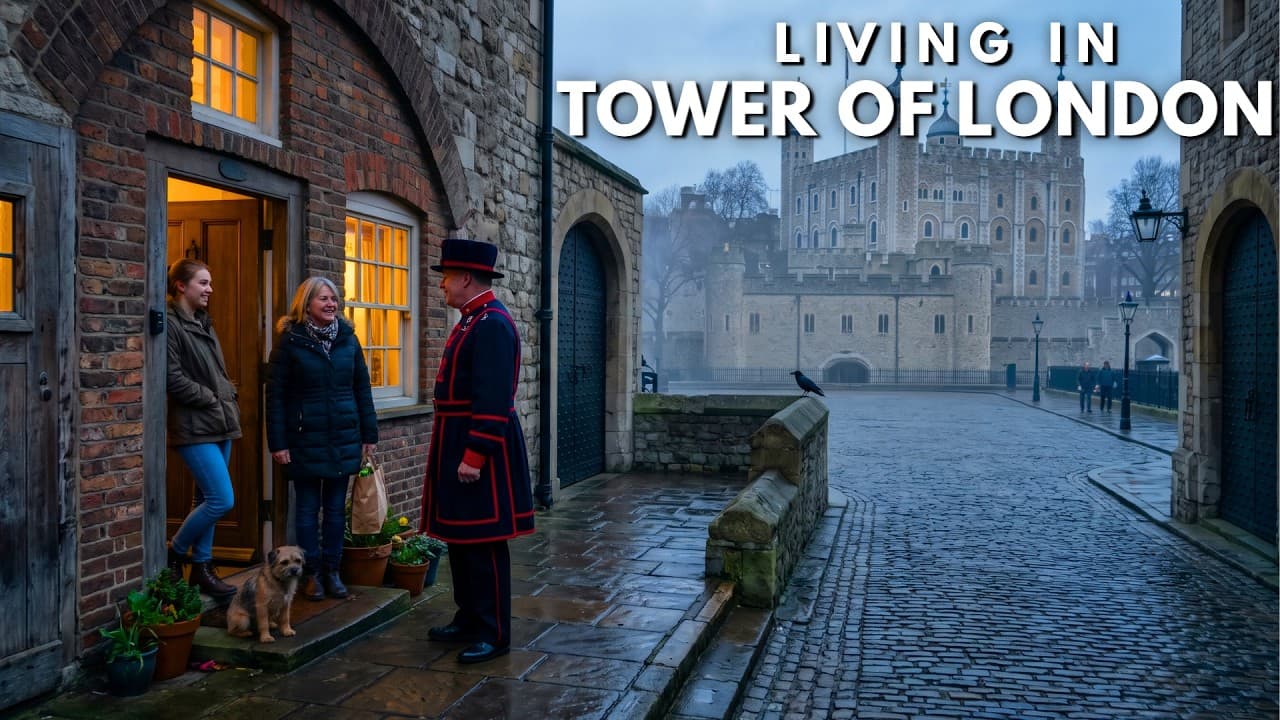
The Tower of London is the most infamous prison in history, and roughly 150 people still call it home. Two queens of England were beheaded on its lawn, two young princes vanished inside its walls, and the last man to die here was shot in 1941. Yet every evening, after the gates close, a community of retired soldiers, their families, a doctor and a pub carry on an ordinary life inside a fortress that has stood beside the Thames for nearly a thousand years.
This guide takes the Happy Living film on living inside the Tower and fills in the history behind the stones: who was held here and why, what the Yeoman Warders actually do, why the ravens matter, and how to see all of it without spending half your day in a queue.
Watch the Film First
The film walks the fortress from the moment the first visitors pour through the gate to the moment the last key turns at night. It spends time at the execution site on Tower Green, in the Jewel House with the Crown Jewels, and at the raven enclosures, but its real subject is the people who never leave. You meet the Yeoman Warders in their dark blue everyday uniforms, hear how a soldier earns the right to live here, and watch the Ceremony of the Keys, the nightly locking-up ritual that has been performed, in one form or another, for roughly seven centuries. For a Halloween season film, it is unusually gentle. The ghosts are in the history, not the special effects.
A Thousand Years of Prisoners and Executions
William the Conqueror began the White Tower around 1078, a decade after his victory at Hastings, and he built it to intimidate. Later kings wrapped it in two rings of walls and a moat, and by the time Edward I added the water entrance now known as Traitors' Gate in the late thirteenth century, the Tower was a royal palace, an armoury, a mint, a zoo and a prison all at once. Prisoners arriving by barge passed under that gate and understood, as they were meant to, that the river was the only way out.
The Tower's reputation was built on the people it held. The two sons of Edward IV, the Princes in the Tower, were lodged here in 1483 by their uncle, who became Richard III, and were never seen again. Anne Boleyn was executed on Tower Green in May 1536, by a swordsman brought from France at her own request, and buried in the chapel of St Peter ad Vincula a few steps away. Catherine Howard, Henry VIII's fifth wife, followed her in 1542. Lady Jane Grey, queen for nine days, was beheaded in 1554 at the age of about sixteen. Guy Fawkes was questioned and tortured here after the failed Gunpowder Plot of 1605. Sir Walter Raleigh spent roughly thirteen years in the Bloody Tower, where he wrote a history of the world before his eventual execution at Westminster.
The detail that surprises most visitors is how rare executions inside the Tower actually were. Only a handful of prisoners, mostly royalty and nobility, were beheaded privately on Tower Green. The vast majority of the condemned were marched out to Tower Hill, just beyond the moat, and executed in front of enormous crowds. The Tower was a prison, but it was first and foremost a place to hold people whose status demanded security rather than squalor. That changed in the twentieth century. The last execution of all took place in August 1941, when Josef Jakobs, a German agent who had parachuted into Huntingdonshire with a broken ankle, was shot by a firing squad while seated in a chair in the miniature rifle range.
The Village Inside the Walls
What the film captures best is the part of the Tower no guidebook can show you: the life that begins when the day visitors go home. The fortress is guarded and populated by the Yeoman Warders, nicknamed Beefeaters, and they are not actors. Every one of them is a former senior non-commissioned officer from the British Armed Forces with at least 22 years of service and a Long Service and Good Conduct medal. There are roughly 35 of them, and they live inside the Tower with their spouses and children in flats tucked into the medieval casemates along the outer wall. Their rent comes out of their salary, they have a resident doctor and a chaplain, and they drink at their own private pub, the Yeoman Warders Club, which is not open to the public.
The Warders have been at the Tower since Henry VII formed the body in 1485, originally as royal bodyguards. Today their duties are a blend of tour guiding, ceremonial work and genuine security. The most famous ceremony is the Ceremony of the Keys. Each night at about 9:53 pm, the Chief Yeoman Warder, carrying a lantern and the Queen's Keys, is escorted by soldiers of the Tower Guard to lock the outer gates. At the Bloody Tower a sentry challenges him with "Halt, who comes there?", the keys are answered for, and the party is allowed through. The ritual has run without a break for roughly 700 years, and the Tower is fond of pointing out that even German bombing during the Blitz only delayed it by half an hour.
Then there are the ravens. The legend, usually attributed to the reign of Charles II, holds that if the ravens ever leave the Tower, the White Tower will crumble and the kingdom will fall. The Tower takes no chances. At least six ravens are kept at all times, with a spare or two in reserve, and they are cared for by a Yeoman Warder with the title of Ravenmaster, who feeds them raw meat and blood-soaked biscuits and has their flight feathers lightly trimmed on one wing so they stay close to home. The birds are named, mischievous and surprisingly long-lived. If you have read our guide to Halloween's origins in Ireland, the ravens fit the same pattern: a very old superstition that a modern institution has decided it would rather not test.
What It's Really Like to Visit
The Tower is one of the most visited paid attractions in Britain, which means the experience depends almost entirely on timing. Get the timing right and it is one of the great historic sites in Europe. Get it wrong and you spend forty minutes shuffling past the Crown Jewels on a moving walkway.
- Best time to go: October is ideal. The summer crowds have thinned, the light on the stone is soft and low, and the Halloween season brings extra evening events. Winter weekdays are quietest of all.
- Tickets and opening hours: Book online in advance through Historic Royal Palaces; it is cheaper than the gate price and lets you skip the ticket queue. Adult tickets run roughly £35, with reductions for children, students and families. The Tower opens at 9 am Tuesday to Saturday and 10 am on Sunday and Monday, closing at about 5:30 pm in summer and 4:30 pm in winter, with last entry around an hour before. Arrive for opening and go straight to the Jewel House first, before the tour groups, then work backwards through the rest of the site.
- The Crown Jewels: The collection includes the crowns, orbs and sceptres still used at coronations, including the Cullinan I diamond in the Sovereign's Sceptre. The display is on slow-moving walkways. Photography is not allowed inside.
- Ceremony of the Keys: Free, but tickets must be booked well in advance online, and they are released months ahead and go quickly. You enter at about 9:30 pm, the ceremony lasts roughly half an hour, and no photography or recording is permitted. Dress warmly; you will be standing on cobbles in the dark.
- Yeoman Warder tours: Free and included with your ticket. Tours leave from just inside the main entrance about every 30 minutes and last roughly an hour. They are the best thing at the Tower, funny, gruesome and well rehearsed. Take the first one of the day.
- Getting there: Tower Hill station on the District and Circle lines is a two-minute walk away. Tower Gateway on the DLR and Fenchurch Street rail station are also close, and Uber Boat by Thames Clippers stops at Tower Pier if you want to arrive by river, which is still the most atmospheric way in.
- Costs: Allow three to four hours. Food inside is limited and priced for a captive audience, so eat before you arrive or walk to St Katharine Docks next door afterwards.
- Etiquette: Do not feed or touch the ravens; they bite, and the Ravenmaster will not be amused. Stay off the roped areas on Tower Green, which is treated as a place of burial rather than a lawn. Keep voices down in the chapel of St Peter ad Vincula.
- Weather: Most of the site is outdoors and the stone courtyards funnel the wind off the river. Bring a waterproof layer and a compact umbrella whatever the forecast says, and wear shoes you can stand in on cobbles for several hours.
If the Tower leaves you wanting more of the dark side of European history, the castles and legends in our Transylvania travel guide make a natural next stop, and readers who prefer their ghosts on this side of the Atlantic should read about the haunted battlefield at Gettysburg.
What to Pack for London
You will be on your feet for most of the day, outdoors for much of it, and the weather in London changes its mind every hour.
Affiliate picks, not a shopping checklist. Use what you own first. Check the listing's model, size, seller and current availability before purchasing.
Rick Steves London Travel Guide
The most useful guidebook for a first or second visit to London, with a solid self-guided Tower walk and honest advice on what to skip. Check for the latest edition.
Tower of London History Book
Read the stories of the prisoners, executions and Yeoman Warders before you arrive and the stones will mean far more when you stand on Tower Green.
Compact Travel Umbrella
London rain is non-negotiable, a compact umbrella is always in the bag. Pick one that folds small enough for a coat pocket.

Osprey Farpoint 40
Ideal carry-on for a London trip. Fits airline cabin limits, opens like a suitcase and carries comfortably on the Tube and between stations.
FAQ
Do people really live inside the Tower of London?
Yes. The Yeoman Warders and their families live in flats inside the walls, alongside the Resident Governor, the Tower's chaplain and doctor, and a small number of other staff. In total about 150 people are resident, and they are locked in each night after the Ceremony of the Keys.
Was anyone executed inside the Tower of London?
Only a small number of people were executed within the walls, on Tower Green, and they were almost all royalty or high nobility granted a private death, including Anne Boleyn, Catherine Howard and Lady Jane Grey. Most condemned prisoners were executed publicly on Tower Hill outside the moat. The last execution inside the Tower was in 1941, when German spy Josef Jakobs was shot by firing squad.
Is the Ceremony of the Keys worth booking?
If you can get a ticket, absolutely. It is free, it has been performed nightly for roughly 700 years, and it is one of the few ways to see the Tower after dark and almost empty. Tickets are released online by Historic Royal Palaces months ahead and sell out fast, so plan it as early as your travel dates. Arrive on time; latecomers are not admitted.
How long do you need at the Tower of London?
Plan on three to four hours to see the Crown Jewels, take a Yeoman Warder tour, climb the White Tower and walk the wall circuit. A rushed visit can be done in two hours if you go at opening and head to the Jewel House first.
Watch More from Happy Living
The Tower is one stop on a longer journey through how people actually live in the places the world thinks it knows. Browse the full Happy Living film collection for the castles of Transylvania, the haunted fields of Gettysburg and the quiet wealth of Switzerland, or subscribe on YouTube to catch each new film the week it is released. The journal has a companion guide for every destination.