Living in Switzerland looks, from the outside, like a solved problem. The trains leave on the minute, the lakes are clean enough to swim in from the city center, and the average salary is among the highest on Earth. Spend a week here and a different picture forms: a country where wealth is real but quiet, where "free" healthcare is actually a monthly bill everyone pays, and where the daily rhythm is shaped as much by rules and routines as by money.
This guide takes the Happy Living film on everyday Swiss life and fills in what a visitor actually needs to know about Switzerland: how the system works, what it costs, where the Alps are easiest to reach, and why the fondue is not just a tourist trick.
Watch the Film First
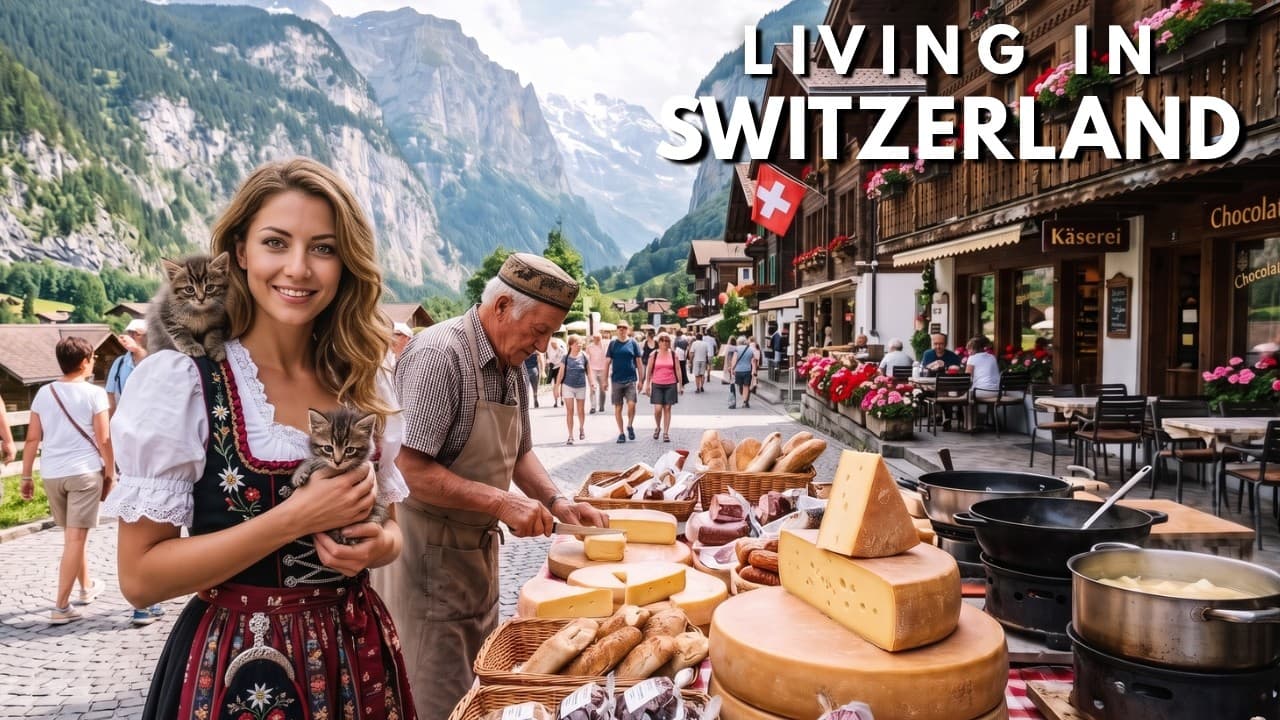
The film follows ordinary days in Switzerland rather than a highlight reel. It moves between Zurich's financial district and lakeside baths, Geneva's international quarter, and the mountain villages where the postbus is still the main way in and out. Along the way it asks a simple question: when a country is this rich, what does that wealth actually buy for the people who live there? The answers turn out to be less about luxury and more about reliability, from the healthcare appointment that happens when promised to the train that connects a village of 400 people to the capital four times an hour.
How Swiss Wealth Actually Works
Switzerland's reputation for money rests on banking, pharmaceuticals, precision engineering and a very old habit of staying out of other people's wars. The result is a GDP per person well above its neighbours and a currency, the Swiss franc, that has become a safe harbour whenever the rest of the world looks shaky. What surprises most visitors is how little of that wealth is on display. The richest neighbourhoods on Lake Zurich are leafy and understated. Cars are modest. Showing off is faintly embarrassing in Swiss culture, and the typical signs of a rich person are a good watch, a well-kept apartment and a lot of time spent outdoors.
The wealth also comes with a price tag that catches travelers off guard. A coffee in Zurich costs the equivalent of five or six US dollars, a basic lunch runs twenty to thirty, and a night in a mid-range hotel can easily pass two hundred. Salaries scale to match, so residents feel it less than visitors do. Locals shop at Migros and Coop, the two cooperative supermarkets that anchor every town, and many people living near the border drive into Germany or France for groceries. Nothing about this is a secret; it is simply how the country runs.
Then there is the healthcare question the film's title raises. Swiss healthcare is universal, excellent and not free. Every resident is legally required to buy basic health insurance from a private insurer, with premiums that average several hundred francs a month per adult, plus an annual deductible, called a franchise, that you choose yourself. Lower-income households receive premium subsidies from their canton. Nobody is turned away and nobody goes bankrupt over a hospital stay, which is why residents often describe the system as "free" in conversation, but the money arrives through monthly bills rather than taxes. Visitors are covered by their own travel insurance, and should carry it, because a Swiss emergency room charges Swiss prices.
Everyday Life: Rules, Routines and the Alps Next Door
The second thing the film captures well is how organized daily life is. Switzerland runs on quiet rules. Recycling is sorted into a dozen categories. Many apartment buildings still have agreed laundry days. Sunday is genuinely quiet: shops close, lawnmowers stay in the shed, and people head for the hills. Visitors sometimes read this as stiffness. It is closer to a shared agreement that life is better when everyone can count on everyone else, and it is the same instinct that makes the trains run to the minute.
The Alps are not a destination here; they are the backdrop to an ordinary Tuesday. A bank employee in Zurich can be on a mountain trail within an hour. School children in the valleys ski the way kids elsewhere play football. The Swiss Travel System, the combined network of trains, postbuses, boats and cable cars, is what makes this possible, and it is the single most useful thing a traveler can understand about the country. A ticket from Zurich to Zermatt or Interlaken is a seamless chain of connections, timed so that one vehicle waits for the next.
Switzerland is also four countries in one. German is the majority language, but Geneva and the west speak French, Ticino in the south speaks Italian, and a few valleys in Graubünden still speak Romansh. Each region has its own food, humour and pace. The fondue culture the film shows is strongest in the French-speaking west and the Alpine cantons; a proper fondue moitié-moitié, half Gruyère and half Vacherin, is a winter ritual rather than a year-round tourist dish. Order it on a cold evening in Fribourg or Gruyères and it makes sense. Order it in July in a Zurich tourist restaurant and you are paying for the idea, not the experience.
What It's Really Like to Visit
Switzerland is one of the easiest countries in the world to travel in and one of the most expensive. Both facts shape the trip.
- Best time to go: June to September for hiking and open mountain passes; December to March for snow. May and October are quieter and cheaper but some cable cars and mountain hotels close between seasons. Autumn brings golden larch forests in the Engadin that rival anything in Kyoto.
- Getting around: Buy a Swiss Travel Pass if you plan to move most days; it covers trains, buses, boats and many museums. For a single base, a regional pass or the half-fare card is usually better value. Use the SBB app for timetables and tickets.
- Where to base: Zurich for city life and lake swimming, Lucerne for the classic lake-and-mountain combination, Interlaken or Lauterbrunnen for the Bernese Oberland, Zermatt for the Matterhorn, and Geneva if you want the French side and easy access to the vineyards of Lavaux.
- Costs: Budget at least CHF 150 to 200 per person per day even when sleeping in hostels or budget hotels and eating from supermarkets. Picnics are a Swiss tradition, not a compromise; grab bread, cheese and a bottle of Rivella and eat by the lake like everyone else.
- Etiquette: Say hello when you enter a shop, "Grüezi" in German Switzerland and "Bonjour" in the west. Keep noise down after 10 pm and on Sundays. Wait for the light at pedestrian crossings even when the road is empty.
- Tap water: Free, excellent and available from public fountains in every town. Carry a bottle and refill it; buying water here is a rookie expense.
- Mountain safety: Trails are superbly marked, but check the weather and cable car closing times. A warm layer and rain jacket belong in your bag even on a sunny valley morning.
The same quiet, well-ordered wealth appears in our Norway travel guide, and comparing the two countries is a useful way to think about what "rich" actually means.
What to Pack for Switzerland
Travel light. You will be lifting your bag onto trains and into cable cars several times a day, and the weather can swing from lake sunshine to mountain sleet in a single afternoon.
Affiliate picks, not a shopping checklist. Use what you own first. Check the listing's model, size, seller and current availability before purchasing.
Victorinox Swiss Army Knife
The original Swiss Army Knife, a travel essential from the country that invented it. Pack it in checked luggage, never in a carry-on.
Rick Steves Switzerland Travel Guide
The most practical guidebook for Swiss trains, mountain passes and small-town stays. Check for the latest edition.

Universal Travel Adapter
Switzerland uses Type J plugs that even many European adapters miss. This one covers every country on your route.

Osprey Farpoint 40
The carry-on-friendly pack that keeps up with Swiss trains. Fits in overhead racks and under postbus seats.
FAQ
Is healthcare really free in Switzerland?
No. Switzerland has universal healthcare, meaning everyone is covered, but it is funded through mandatory private insurance premiums rather than taxes. Residents pay several hundred francs a month per adult plus a deductible, and low-income households receive subsidies. Tourists are not covered and should carry travel insurance with medical coverage.
Is Switzerland too expensive to visit on a budget?
It is expensive, but it can be managed. The biggest savings come from a rail pass bought in advance, supermarket meals and picnics, hostel or guesthouse stays, and free activities like hiking, lake swimming and walking the old towns. Expect to spend more than you would in neighbouring countries no matter how carefully you plan.
Do I need a car in Switzerland?
Almost never. The Swiss public transport network reaches villages, trailheads and mountain summits, and timetables are integrated so connections wait for each other. A car is only worth it for remote valleys or if you are combining Switzerland with rural parts of France or Italy. Parking in cities is scarce and costly.
What language should I use?
German in the north and center, French in the west, Italian in Ticino. English is widely spoken in cities, hotels and on the tourist rail routes, but a greeting in the local language is appreciated. Swiss German is very different from the German spoken in Germany, though everyone understands standard German.
Watch More from Happy Living
Switzerland is one stop on a longer journey through how people actually live in the places the world thinks it knows. Browse the full Happy Living film collection for Norway's fjords, Japan's snowiest city and the haunted battlefields of Pennsylvania, or subscribe on YouTube to catch each new film the week it is released. The journal has a companion guide for every destination.